[Newspaper]
Publication: The Cincinnati Post
Cincinnati, OH, United States
no. 2975, p. 3, col. 3
EASY CHAIR FARMER
Home Life of the Indiana
Democratic Candidate.
HIS VIEWS ABOUT FARMING.
The Alliance. He Thinks, Will
Co-Operate With the Democracy
on the Tariff Question.
CLINTON, Ind., Sept. 15. — [Special]. — Claude Matthews, the Democratic nominee for secretary of state, resides about three miles from this place.
I have just visited him.
Mr. Matthews gave me a cordial welcome, and began by telling me something about his past life.
Claude Matthews was born Dec. 14, 1845, on a farm in Bath county, Kentucky. His father's family are now residents of Covington. Mr. Matthews received his elementary education at Owingsville, Ky., and graduated at Center college, Danville, in 1867. After graduating he went to Cincinnati, where he remained for about a year. During his sojourn in Cincinnati he considered seriously the question of engaging in the book business in that city, which circumstances prevented him from doing so.
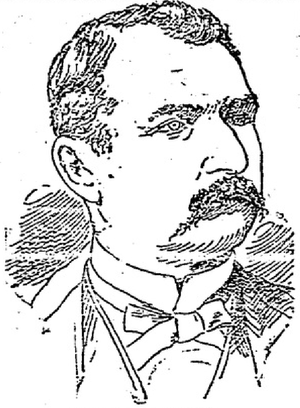 |
| CLAUDE MATTHEWS. |
He was married in 1868, in Ross County, Ohio, to Martha Renick Whitcomb, a daughter of James Whitcomb, the first Democratic governor of Indiana, and afterward United States senator. They had four children, three of whom are living. One is the wife of state senator Ewing, of Greensburg. A son attends the Holytechnic [sic] Polytechnic school at Terre Haute, and is taking a course in mechanical engineering: “a course,” said Mr. Matthews, “which fits a young man for trade and gives him a correct idea of the dignity of labor.” A daughter named Helen, who is about 12 years of age, attends the public school at Clinton. One of Mr. Matthews’ sisters married D. M. Massie, at present a member of the Ohio Senate, and another is the wife of R. G. Hemingray, of Covington.
Mr. Matthews came to this county (Vermillion ) in the spring of 1869, and immediately engaged in farming, a pursuit which he has followed ever since. He engaged largely in the breeding of short horned cattle, and has been one of the leading breeders of that class of stock in Indiana.
Speaking of his farm, Mr. Matthews said: “originally 1200 acres, it is now 1900. There were, in 1869, about 600 acres in cultivation; now there are about 1400, besides quite an area devoted to permanent pasture. The average yearly cultivation of corn is from 600 to 700 acres, and of wheat from 300 to 450 acres, the rest of the cultivated land being in oats, rye and meadow. I give personal supervision to the whole farm.
“I have eight tenement farmers, to whom I rent part of my land on the terms usual in this section of the state, viz: ‘grain rent’. I usually employ about six farm hands, who cultivate the land that I personally farm. I think I can say that my land is some of the best farming land in Indiana.”
The first thing that strikes the eye, as one approaches Mr. Matthews’ residence, is a beautiful view to the South — Brouillett’s Creek Valley — so called from one of the old French families who came from Vincennes in early times, and established a mission.
Mr. Matthews lives comfortable, but not luxuriantly. After chatting pleasantly for a while with the members of his family, he asked me to take a little jaunt with him over the farm. We first visited the fish ponds, which were well stocked with carp and catfish, and then looked at some fine stock, notably “jerseys” and “yearlings.”
Returning to the house, Mr. Matthews showed me his library, containing about 1200 carefully selected and valuable books. He's quite proud of it, and says that he finds much pleasure in reading aloud to the members of his household.
Alinding [sic] Aligning to the claims of his political opponents that he is an “alleged farmer,” Mr. Matthews said: “I am aware that the general conception of a farmer among those who make such a claim is that he should appear on all occasions with pants stuck down in cow hide boots, a slouch hat, and a not too clean gingham shirt. But I see no reason why a farmer should not be a gentleman of culture and make a good appearance among his fellow men Certainly as high an order of intelligence is required in farming as in any other avocation in life. Because a farmer may not personally do all the work connected with a farm, it doesn't follow that he is not a practical farmer. Why, in these days one man couldn't work a large farm by himself. The manufacturer doesn't go into his shop and take a hand in its practical operations; yet he is nonetheless a manufacturer.”
Mr. Matthews says he has never been anything but a Democrat, and treats as absurd stories in circulation to the contrary. In 1876 he was elected to represent Vermillion county in the state legislature, being the first Democrat ever elected to the General Assembly from the county. In 1880 he was a candidate for the democratic nomination for lieutenant-governor. In 1882, as the Democratic nominee for joint senator from Parke and Vermillion counties, he reduced the Republican majority 600. At the time of his nomination for Secretary of State he was the nominee of the Democrats for state senator.
Regarding the attitude of the farmer's alliance towards the two parties, Mr. Matthews said: ”The alliance would be more apt, I think, to favor the Democratic than the Republican idea of the tariff. The tariff question is freely discussed at their meetings and without regard to party, the McKinley bill is condemned. Many farmers, who have heretofore been Republicans, are with us now on the tariff question. A number of the grievances complained of by the F. M. B. A. are attributed to the present tariff. The members feel that there has been unjust discrimination against the farmer in favor of the manufacturer. I am inclined to think that Blaine's reciprocity idea is not broad enough in its score to be acceptable to the farmers.”
Mr. Matthews says the F. M. B. A. in Indiana has a membership of at least 8000, and that is becoming stronger every day.
While discussing a new election law, Mr. Matthews said it would help the Democrats, and would, among other things, prevent the intimidation of employees which has prevailed in some of the large manufacturing cities of the state.
C.N. VALLANDIGHAM.
