[Trade Journal]
Publication: Arnold Bulletin
Chicago, IL, United States
no. 5, p. 3-9, col. 1-2
The Lansing, St. Johns & St. Louis Railway.
This article which is descriptive of some of the construction work done by the Arnold Electric Power Station Co. during the summer of 1901, was written by B. B. Sanborn, of the "State Republican," Lansing, Mich., and was selected from a number submitted by writers on the local papers.
An excursion train consisting of a caboose and two canvas covered flat cars recently made the round trip from St. Johns, Michigan, to Lansing, the capital city of the state, and thus marked, in an informal way, the opening of traffic over part of the electric road known as the Lansing, St. Johns & St. Louis Railway. The excursionists were more than one hundred of the business men of St. Johns, who by invitation of Mr. John E. Mills made the trip for the purpose of inspecting the new line and of visiting the sugar factory at Lansing which is operating for its first season.
This informal opening of the twenty miles of the road was an event of interest to two counties not only because this line is the first electric interurban system in this part of the country, but because it is the only direct route by which people living to the north may reach the capital city by rail. Eventually as the electric lines which are now being pushed through from Detroit and other southern parts of the state are completed to Lansing this road will become parts of a vast system of electric interurban roads which is spreading like a net work over all of Michigan, Indiana, Ohio and adjoining states.
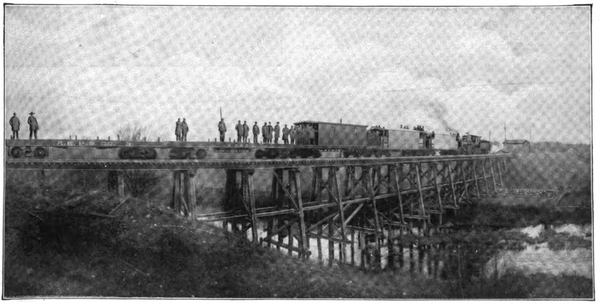 |
| The Opening Excursion — on Looking Glass River Bridge. |
The Lansing, St. Johns & St. Louis Railway is the result of the enterprise of Frederick Thoman, Jacob Stohl and Frank L. Dodge, of Lansing, Dr. Stiles Kennedy and A. B. Darragh of St. Louis, Isacca Hewitt of Maple Rapids, and Fred Norris, John E. Mills and E. F. Percival of Port Huron. The right of way for the road was at first secured along the public highways, but this policy was finally determined to be impracticable, and a private right of way, 66 feet wide, was purchased. The securing of the franchises through the towns, the buying of the right of way, and the entire financial responsibility has been successfully undertaken by Mr. Mills.
The Construction Company.
The contract for building and equipping the road complete was awarded to the Arnold Electric Power Station Company, Engineers and Contractors, of Chicago, who have handled all the technical details. This Company has had a successful experience in building electric railroads and has developed an organization capable of handling contracts of any magnitude. This organization includes a competent corps of engineers skilled in all the details of electric road building, from the design of a culvert or the planning of a bridge to the detailing of a central power plant, or the selection of proper rolling stock. The complete contract for this road, therefore, included the engineering as well as the actual construction work. The line was surveyed and located by the Arnold Company's engineering party under the supervision of H. L. Cleverdon, civil engineer, and the construction work has been in charge of Superintendent H. B. Quick, assisted by E. B. Arnold in charge of material yards.
The Benefits to the Farmers.
The initial trip over the new tracks was full of enjoyment for everyone. Ordinary people are sufficiently unacquainted with railroad building to make the most commonplace details of construction interesting, and the benefits that are in plain sight for the people along the line are enough to quicken the most sluggish imagination. The course of the road is through a rich farming country, and one moreover, that is especially well adapted to the culture of sugar beets. The successful campaign of the Lansing sugar factory, and the stories of the profits received by the beet growers near the city have awakened the liveliest interest in the subject in every nearby town and farm. Farmers living near the line of the Lansing, St. Johns and St. Louis road are only waiting until the line is finished to begin growing beets. This line having been built for the avowed purpose of handling freight in carloads, will carry beets almost to the doors of the sugar factory, and for a rate that will make it possible for them to be shipped with profit.
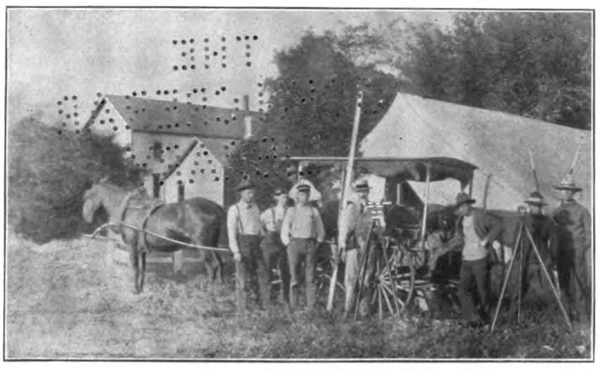 |
| An Early Morning Start. |
It has developed, too, that the building of the road has settled another important question for the farmers, namely, how to dispose of their surplus milk. The Michigan Condensed Milk Works situated in Lansing, has already arranged to receive shipments of milk from places that are practically inaccessible to it at present.
Clinton county, its business men say, will feel the benefits of the road in many ways, but in none more, probably, than in the rearrangement of the rural mail routes. By a recent order, the Post-office Department has made Clinton the first county in Michigan to have complete rural delivery. This would have been practically impossible without a way to deliver mail to carriers at different points, thus enabling each to go out and return over a portion of territory not covered by any other carrier.
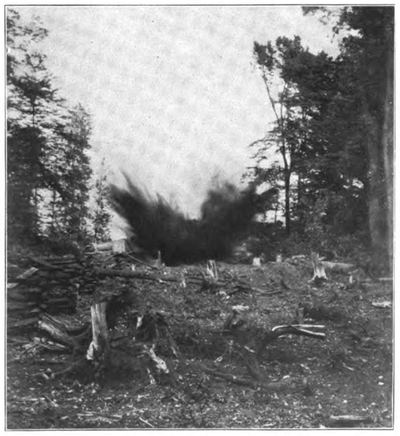 |
| Blasting the Right of Way. |
Along with the mail routes have come the rural telephone system, and now that there is added an easy means of communication with towns and neighboring farms, the solitude that has been the bane of life on the farm has gone forever.
Everyone sees instantly all that the electric road will mean to him in a business way, but no one but the farmer himself can fully value this greater benefit of the changed and improved social conditions. With cars going by his door every hour, the farmer is no more shut out of social life and entertainment than the man in the town. The advent of the electric road is also the advent of civilization in many communities; the stagnation of thought, the intellectual and social deterioration consequent upon living comparatively isolated lives are evils of the past, and no one is more fully aware of the fact than the people most interested.
The Road to be Extended.
Another season will see still larger territory reached. The twenty miles of road between Lansing and St. Johns is but one-third of the proposed length of the line, which is to extend finally to Alma and St. Louis, a distance of sixty miles. The towns of DeWitt, St. Johns, Maple Rapids and Ithaca will thus be included in its route. These towns, as has been stated, have had no direct communication with each other and no convenient way of reaching Lansing. This connection the Lansing, St. Johns and St. Louis road is intended to supply.
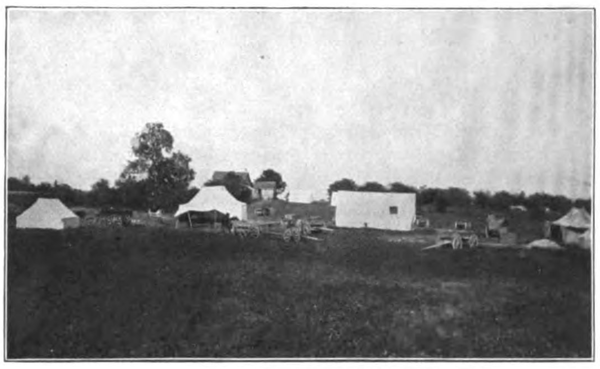 |
| A City of Tents. |
The Engineer's Shanty.
All these points were duly considered by the St. Johns excursionists as their train rounded the gentle curves or flew past cosy [sic] cozy farm houses on its southward way. One of the sights of the road that was eagerly watched for by the visitors was the engineer's shanty. The engineer and his assistants have become familiar figures everywhere along the line, as they have been on the ground since the first, and were in fact almost the first visible evidence that work was really begun. Civil engineers are a class by themselves. Men of equal ability, conducting important work of other sorts, are furnished handsome offices carefully supplied with every convenience. Civil engineers while in the field know nothing but the work; their world is the right of way and its inhabitants the men who work upon it. The typical engineer's shanty is, in consequence, like this one occupied so long by the Arnold Company's engineers at Lansing, a long, low, unpainted building; comfortable, but furnished only with the necessities with which the men who build railroads content themselves while at work. In this unpretentious building the Arnold Company's engineer with his competent corps of assistants has lived since the first surveys were made.
The Material Yard.
All material has been forwarded from a material yard at Lansing which is connected by a switch with the Pere Marquette railroad. Electric roads being an innovation in this region this material yard has shared in the general interest excited by the building of the road, and has been from the first a point to be inspected early and late by sightseers. Curiosity has been gratified with the display of orderly piles of cedar ties, carloads of shining steel rails, and above all with the picturesque figures of the Italian workmen employed by noteworthy exception to this simplicity is reported by one of the the Arnold Company.
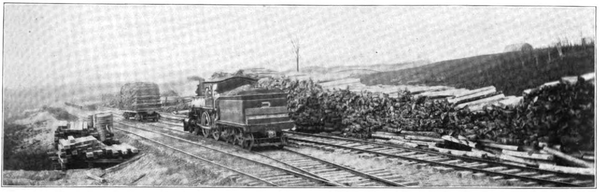 |
| The Material Yard. |
The Italian Village.
The Italians with their village have been a boon to curiosity seekers. The "village" is a group of queer little huts which these people have built for themselves alongside the track to serve as temporary homes. The huts are tiny affairs carelessly constructed of rough boards, somewhat higher than is absolutely necessary to allow for standing upright, but with one side, and sometimes more open to the weather. Usually, as the season has advanced nearby cornfields and haystacks have been made to contribute the necessary chinking for the cabins, and some curious effects have been produced. One hut has been so thickly covered with cornstalks that the foundation material is lost sight of, and the rustling leaves and nodding tassels have made it outwardly fit for the habitation of Mondamin himself. Another has put on a thick jacket of hay that will defy any ordinary gale. The furniture of these dwellings is as primitive as the exteriors. A few stones form a fireplace; a few basins, the cooking utensils, and these with a board placed upon some upright sticks to serve as a table are all the household plenishings these people appear to require to make them comfortable and happy. A noteworthy exception to this simplicity is reported by one of the visitors who saw upon one of the rude tables a thick leather-bound book that showed signs of constant but careful use. Besides these huts the village contains a comfortable board shanty containing a stove and bunks, erected by the construction company for sleeping quarters for the villagers.
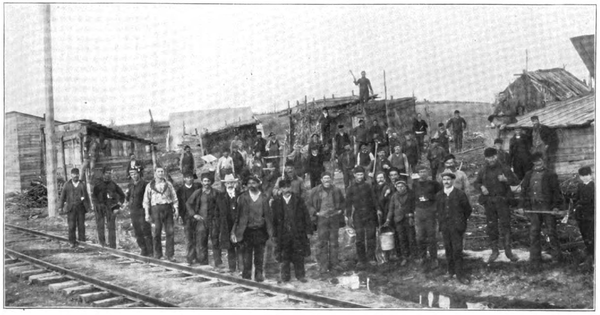 |
| The Italian Village. |
Indifferent as these Italians seem to the common comforts of civilization they make, for certain kinds of work, the best men that can be hired. They are sober, industrious, peaceable, and heartily devoted to the interests of their employers. They earn good wages and save the most of what they earn.
The Pile Driver.
At this end of the road also was found the new pile-driver built by the Arnold Company to do the work on the overhead crossing of the Pere Marquette. Here an engine steadily drives a hammer weighing a ton and having a fall of thirty feet. The piles that are to support the bridge are of Norway pine, heavily capped. This bridge over the Pere Marquette is one of the finest overhead bridges in Michigan. The specifications are the same as for bridges used on standard steam roads. Nothing but the best of material has gone into the construction, and it will bear as heavy traffic as will the bridges on any steam road in the state. Its length is over twelve hundred feet, and it is to be twenty-two feet above the Pere Marquette. Every bridge on the line is built in a similar manner. There are many crossings over small streams and the same solid construction has everywhere been used. Looking-glass River bridge is of the same pattern as this over the Pere Marquette.
The Men at Work
To at least some of the excursionists the return trip to St. Johns was the most interesting part of the day's experience. A general impression only was obtained on the way down, but upon returning each detail separated itself from the general view, and was of distinct interest. Having seen the Italian village, everyone was much more interested in the men themselves who were seen at work on the track, and who, moving slowly out of danger as the engine came in sight, leaned on their shovels to watch the flying train, smiled and saluted at seeing an officer of the company, and contentedly resumed their work of ballasting or loading rails when the train was past. These salutes, which were always carefully returned, brought to the notice of the onlooker the system by which such a body of men is managed. The organization is almost military in its character; obedience is as prompt and complete as if the workmen really wore Uncle Sam's blue. Men neither wait for an explanation nor for the repetition of an order. Knowing the officers, especially Superintendent Quick, one realizes that with them no other system is possible and that the voice of the superintendent is absolute authority.
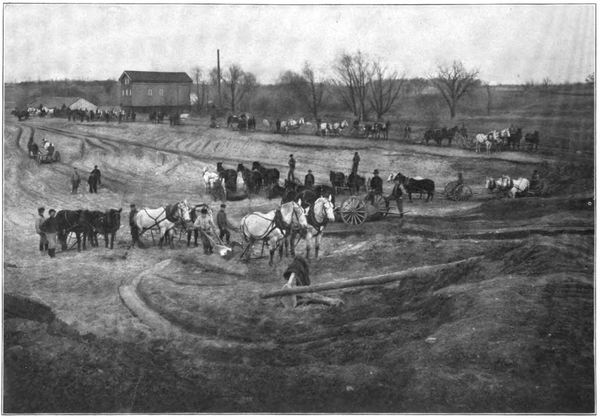 |
| The De Witt \"Borrow Pit\". |
One of the most interesting sights to the visitors was a work train unloading ties where the rails had been laid. The rails had been put down on as few ties as possible and the spaces between were left until an engine could bring the carloads required to fill the gaps. As the train passed slowly along, a foreman in charge stood on a car in front of the ties and counted the number of ties required at each spot. This number he called out to the laborers riding behind him on the ties themselves. At his command the proper number was raised on end, and at his shout of "throw!" the ties were pitched from the car all together and left at the side of the road where they were needed. The careful count, the quick command and the ready obedience made a vivid illustration of what it means to handle men successfully.
At no great distance from Lansing the train stops at a water tank that stands at the edge of a slope down which half a dozen tiny streams flow and lose themselves in a marsh, and which in the summer is a pretty spot shaded by drooping elms. When the trip was made the first icicles of the season hung from the top of the water tank.
The Pole Gang.
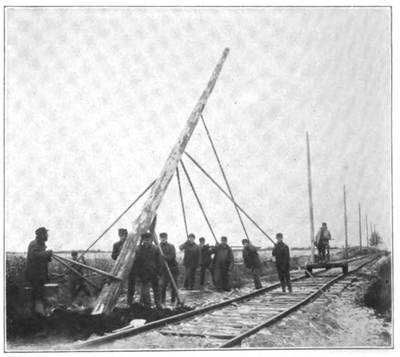
Shortly after leaving the water tank the pole gang began to be seen beside the track, placing or setting the trolley poles and the company's private telephone wire. These poles are placed eight foot from the center of the track. The work, like every part of the building, is in the hands of a foreman who knows how to get the best results with his men, and this part of the construction is as solid as any other.
Cuts and Fills.
Two miles from De Witt the road passes through what is known to the engineeers [sic] engineers as Clayton's cut. This is the greatest cut on the line, and is two thousand feet long and thirteen feet deep. The soil of the farm through which the road runs is of yellow clay, and the time, labor and patience expended here makes the place the scene of the most disagreeable of any of the memories of the road. For days before the work was finished horses tugged endlessly at the heavy plows whose points broke like rotten wood in the tough soil. The smooth yellow sides of the cut that now face the beholder tell their own story of resistance but final surrender to human strength and skill.
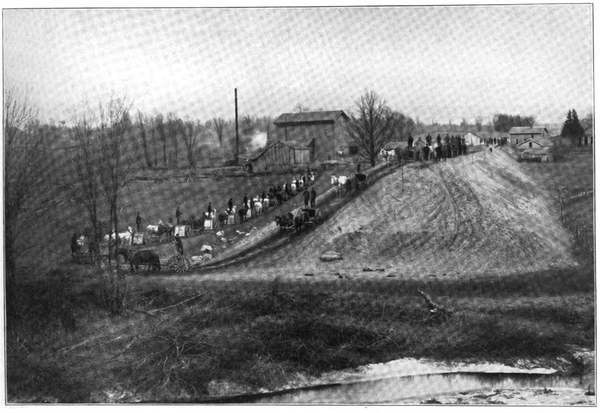 |
| The De Witt Fill. |
As the train approaches DeWitt around a gentle curve Looking glass River bridge comes in sight. Looking-glass River is an unassuming little stream whose low banks have required the greatest fill of any place on the road. Twenty-five thousand yards of material were used in bringing the five hundred feet next the bridge up to grade, and for a long way up and down the road the shining sand banks mark the entrance to the town of DeWitt. The bridge itself is three hundred feet long and thirty-three feet high, but built as it is up in the air its appearance is light and graceful in spite of its substantial construction.
The "Sink Hole."
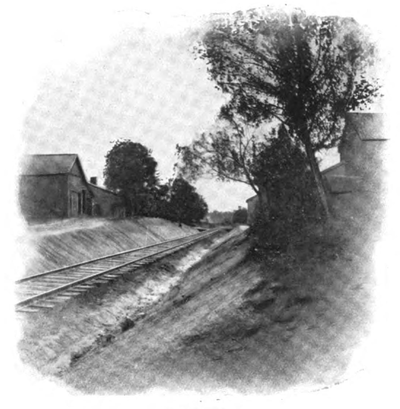
Three miles north of DeWitt the travelers found the famous "sink hole." The people in all the country round have followed with interest the account of the struggle of science with perverse conditions that has been carried on here. An eighth of a mile from the right of way there is a small shallow lake. Between the lake and the railroad lies a field which looks exactly like any other field containing a few scattered trees, and has on the surface nothing to attract the slightest interest. This modest appearance, however, is most deceptive. The field, of which the right of way is a part, is a comparatively thin layer of soil covering what is merely the edge of this concealed lake. A bend to the right would have carried the road away to solid ground, but it has been the policy of the company to build no sharp curves. At every point of the line the question both of curves and grades has been most carefully dealt with. The sharpest curve has a radius of more than a quarter of a mile. There was, on account of this policy, nothing to do with the sink hole but to fill it and go over. The details of that filling would require many columns to describe. Briefly, however, this is the story: A temporary track was laid around the place before the actual process of filling was begun, and earth from a good distance up the line was brought to the spot. The filling process was like trying to stop the mouth of some fabulous monster, an account of whose insatiable appetite would only seem true in a fairy story. Carload after carload of earth was put down, and at last rails were laid across in the faint hope that the creature was satisfied. On a fine day, however, the ground broke away from the planking under the rails and the roadbed was practically afloat. Farmers who had watched the process told doleful tales of wandering cows that had had disappeared, horns and all under the deceptive crust. To match these the railroad men, who are imaginative, responded with truthful stories of fish "feet long" that were discovered swimming in the holes where the filling had disappeared. The catastrophy, not being unexpected by the engineers, put an end to any half-way measures. Orders were to fill as much of the underground lake as might be necessary to secure the road-bed. And these orders have been literally carried out. The steam shovel that loads a car in five minutes was set to work, and thirty-five hundred carloads of sand and gravel will have been used in this place when the work is complete. The roadbed will never go down there again. For yards around there is solid ground where was once shaking bog. As in several other places on the line filling in the road has crowded the loose marsh soil at the sides together until much of it is firmer and more valuable land than it ever was before.
 |
| In De Witt. |
"Long Haired Marsh."
Railroad men, like sailors, bestow quaint names upon places they know. One other boggy place that gave a great deal of trouble between DeWitt and St. Johns was named by the men "Long-haired Marsh," and it is so called by everyone connected with the construction. The name is sufficiently descriptive. The grass growing here was so very much longer than usual that the name is especially appropriate. Like the sink hole, the Long-haired Marsh has been slow to yield to the desire of men to cross. It was found necessary to change the grade here, and finally to plank the marsh from side to side before a foundation was made that was the equal of the remainder of the roadbed. This has been successfully accomplished, and Long-haired Marsh is under subjection.
 |
| The Steam Shovel. |
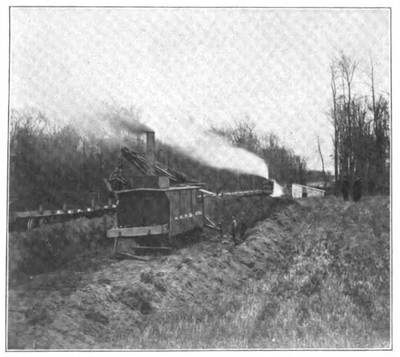
These marshes, of which there are a number on the line, are interesting problems to the engineer. The soil is black muck covered with a thick growth of grass and willows, and sometimes scantily covered with water elms. Where there are any of the latter they are chopped down and the stumps removed with dynamite, as the first step in crossing. The process of strengthening the shaky foundation follows. Filling is used until the loose shifting ground is as firm and safe as if marsh had never existed. Much of this foreign soil has been obtained beside the road itself. An enterprising steam shovel was placed at a convenient spot, long lines of empty cars made a procession to the place where it was at work, and as each car took its place the great shovel scooped the earth with greatest ease, filled a car once each five minutes, and as the full car was pushed away, proceeded to joyfully fill another. The steam shovel, like the pile driver at the other end of the track, does its work with ease and despatch not only pleasant to see but with an almost human enjoyment. The steam shovel was the last of the sights of the road that the train load of first passengers saw as the train returned to St. Johns.
A Permanent Improvement.
The impression produced upon the minds of the excursionists was that the Arnold Company has built a road that will mark a new era in electric road building in Michigan. It would have been thought a very few years ago that for an electric line to plant itself as firmly as a steam road was not only useless but impossible, and that the idea of handling freight in carloads weighing sixty thousand pounds was almost worthy of a madman. The uncommon was tried for at first apparently rather than the substantial. Stories of hair-raising curves or sky-scraping grades over which electric cars were run were all that appealed to the public imagination in the account of the progress of these lines. The day of experiment has gone by. Electric roads belong to the future, and the near future will see them dealt with seriously and with the intention of solving correctly the problems involved in their construction.
 |
| Pole Raising. |
The Lansing. St. Johns & St. Louis Ry. is not an experiment, but a permanent improvement: one of the wealth producing factors of the state. It will handle passengers, mail and freight exactly as if the motive power were steam instead of electricity. It will have some advantages over the steam roads in its frequent stops, as it will thus come into close touch with all classes of its patrons. The construction company has thought of its future in every step of the work, and each problem in engineering has been handled with no other purpose than to reach a final solution. The broad, well ballasted roadbed, the solid, perfectly built bridges proclaim that. Marshes that have vexed the souls of everyone from the president down to the Italian shovel bearer have been converted from shaking bogs into substantial track, and even the wire fence that encloses the right of way looks the best of its kind for the purpose.
A New Electric System.
The most unique feature of the Lansing, St. Johns & St. Louis Ry., however, will be the electric system which has been adopted for the operation of its cars. This system has been designed by Mr. Bion J. Arnold, the president of the Arnold Co., and is intended to overcome the disadvantages now experienced in the operation of long distance high speed electric lines. Upon all recent roads of this character built in this country up to the present time, the system of transmitting high tension alternating currents to sub-stations containing rotary converters has been adopted. Upon some roads storage batteries have been installed in these sub-stations.
 |
| The Fence Gang. |
Mr. Arnold has been engaged in electric railroad building since its inception. He was engineer in charge of the building of the Little Rock, Ark., electric railway in 1891 and designed the power plant for the Intramural Railway at the World's Fair in 1893, both of which installations marked the beginning of important developments in electric railway work.
Mr. Arnold was one of the first engineers in the country to champion the sub-station system, and years ago advocated the adoption of the alternating current rotary converter storage battery sub-station idea for the Chicago & Milwaukee Electric Ry. When this plan was opposed by the disciples of the direct current system, Mr. Arnold offered to and actually did take the contract for installing and guaranteeing the successful operation of the entire system and demonstrated by carrying out the contract that his faith was well founded.
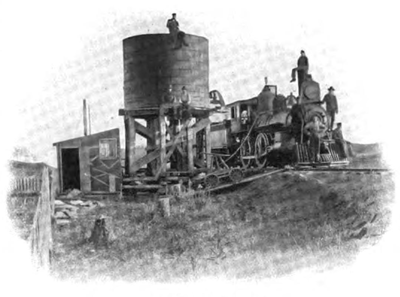 |
| The Water Tank. |
This method of operating electric lines has since been universally adopted by other engineers, but Mr. Arnold believes that its high first cost, its inefficiency in operation, and its inherent complications do not entitle it to be considered a final solution of the long distance electric railroad problem. He is, therefore, bringing his pioneer instincts to bear upon the working out of a much simpler and more ideal system. Little is to be said at the present time of the details of this work, as this article was only intended to cover the interesting work of the Arnold Co. in the actual work of track construction of the Lansing, St. Johns & St. Louis Ry., but sufficient has been said to give an added interest to the progress now being made toward the completion of this line.
