[Trade Journal]
Publication: The Electrical Engineer - London
London, England
vol. 44, no. 1, p. 9-10, col. 1-2
AN IMPROVED FORM OF HIGH-TENSION INSULATOR.
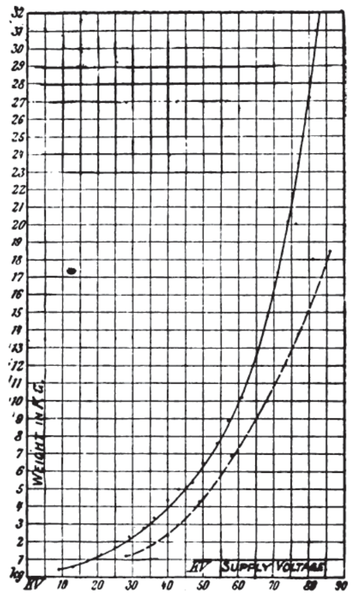
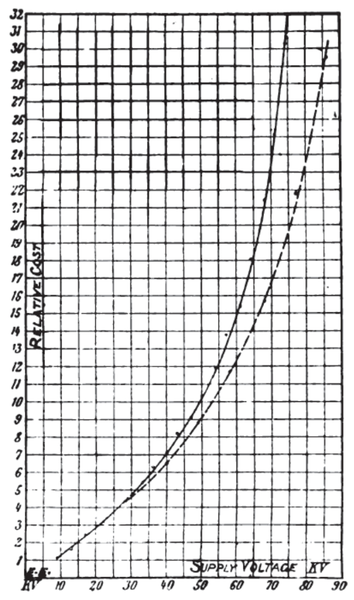
The weight, size, and coot of the ordinary high-tension porcelain insulator increase rapidly with increasing voltage. The increase, in fact, is approximately as the square of the working voltage, as is shown in Fig. 1, in which the full line gives the relation between working voltage and weight of insulator for the standard type made by the Porsellanfabrik Hermsdorf. In Fig. 2 the relative cost of these insulators for the various voltages is shown by the full line. This rapid increase is accounted for by the difficulty of manufacturing large porcelain pieces, and also by the fact that the dimensions have to increase much more rapidly than the voltage in order to avoid the surface leakage which precedes the breakdown.
 |
| Fig. 1. |
 |
| Fig. 2. |
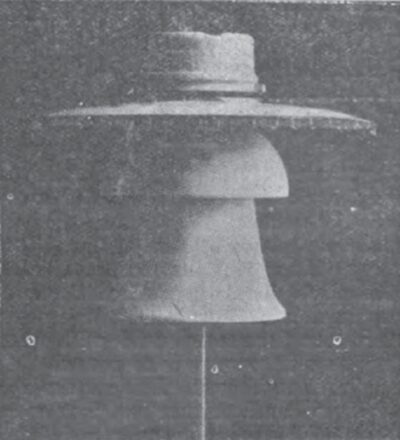
Experiments carried out at the Hermsdorf Porzellanfabrik have shown that the difficulties met with in these large insulators can be removed to a great extent if the upper porcelain plate is replaced by a metal one. This may seem a strange way of improving the insulation, but it, nevertheless, has this effect. In the first place, the upper porcelain plate of any insulator is of little value as insulation, for its outer surface soon becomes covered with water in rainy weather, and its chief purpose is to protect the remainder of the insulator from the wet. This purpose is equally well carried out by a much thinner and lighter metal plate, especially as-the-latter can be easily and cheaply made of larger diameter. The metal cover is also, of course, much less liable to damage by stone-throwing, etc. But besides these mechanical advantages the metal cover has a further purely electrical advantage, for the rain-drops, as they drip off the edge of the cover, are electrostatically repelled much more effectually than in the case of the insulation cover. This action is well brought out in Fig. 3, which shows a metal-cover insulator under high tension, with the drops being thrown outwards and quite clear of the lower part of the insulator. The effect can be enhanced by adding a metal ring beneath and just inside the metal cover. The action is not appreciably interfered with if the metal cover is painted or enamelled to protect it against atmospheric corrosion.
| |||
| Fig. 3. |
The reduced weight and price of insulators designed in this way, especially for the higher voltages, is shown by the dotted curves in Fig. 1 and Fig. 2. Thus, an ordinary porcelain insulator for 80,000 volts weighs 27 2 kg., whilst an equally effective metal-cover insulator for the same voltage weighs only about 15 kg. The cost is also considerably reduced in the latter case.
 |
| Fig. 4. |
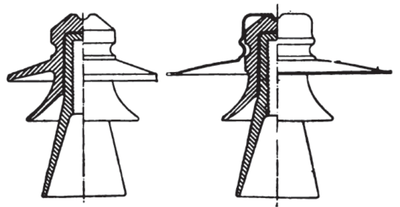
It might be expected that the metal-cover insulators would show a greater loss when under pressure, but experiment has shown that this is not the case. Thus a number of similar insulators were tested at 100,000 volts, half being ordinary porcelain ones and the other half having the upper porcelain plate replaced by a metal cover, as shown in Fig. 4, A and B. Both types showed the same loss, which amounted to about 50 watts per insulator. Certain experiments also show that the metal cover has the effect of improving the electrostatic pressure distribution within the insulator.
| |||
| Fig. 5. |
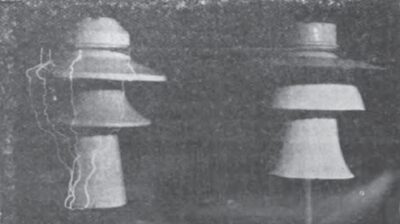
It is found that whilst with ordinary porcelain insulators tested under rain or spray the breakdown is always preceded by surface discharges, this is not the case with the metal cover insulators. In these the breakdown occurs without previous warning, although not until a higher voltage is reached than with the normal insulator. Thus, in Fig. 5 a test of an ordinary and a metal-cover insulator in parallel at 140,000 volts under spray is shown. These insulators are for a working voltage of 80,000, the porcelain one being 39 cm. in outer diameter and 49 cm. in height and weighing 19 kg., whilst the metal-cover one is 50 cm. in outside diameter, 39 cm. in height, and weighs 13.8 kg. A heavy surface discharge is seen to be passing over the porcelain insulator whilst the metal-cover insulator is unaffected. From these experiments it is clear that the addition of a metal cover to many existing porcelain insulators would add considerably to their safe working voltage, and would make many simple indoor insulators of the ribbed type fit for outdoor use.—Elektrische Kraftbetriele and Bahnen.
