[Trade Journal]
Publication: Stone & Webster Public Service Journal
Boston, MA, United States
vol. 25, no. 2, p. 110-113, col. 1
THE KEOKUK INSULATOR TESTER (1)
BY R. B. HOWLAND
For the benefit of those who are not technically informed with reference to high tension insulators and their performance, let us explain that one of the most serious problems connected with the operation of long distance transmission lines is the location and removal of insulators which have become defective because of what is known as "thermal failure." Thermal failure occurs in suspension type porcelain insulator units, which are made up of both metal and porcelain parts. Expansion of the metal parts upon exposure to extreme heat results in fracture of the porcelain. Electrical resistance of the unit is thus reduced to zero. When enough individual units fail in any one string, flashover occurs across the remaining good insulators and the flow of dynamic current through the defective units destroys them. A short circuit between high tension conductor and tower is thus established.
Operating companies make it a standard practice to periodically test all insulators, especially those at dead end and anchor attachments, and to remove such units as may be found defective. Any unit which has failed because of thermal trouble is of zero resistance and quite easily located.
The Mississippi River Power Company operates two 110,000-volt transmission circuits, carried on a single tower line over a distance of 144 miles between Keokuk and St. Louis. On these two lines 87,000 suspension type insulator units are in service, and of this number 50,000 units are located at dead end and anchor tower attachments.
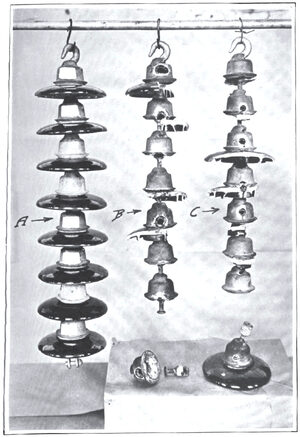
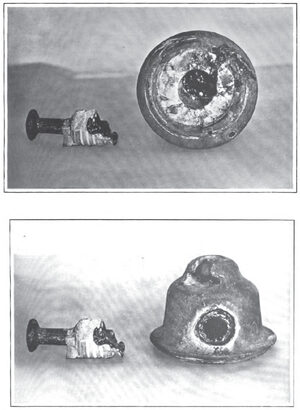
Experience has shown that no matter how thoroughly defective units have been weeded out during the winter and spring months, the first few hot days of summer result in thermal failure of additional insulator units, and if these defective insulators are not immediately located and removed, they become a serious menace to satisfactory line operation. During the present summer season, maximum temperatures at Keokuk did not reach 90° F. until June 12th. On June 16th the thermometer at Keokuk registered a maximum of 92 degrees, and on the 17th the first disturbance, due to thermal trouble, occurred on the St. Louis lines. The second serious disturbance developed on the 18th. The trouble on June 17th resulted from the failure of an insulator string at anchor tower No. 968 in St. Louis County, approximately 136 miles from Keokuk. The flashover on the following day was due to the breakdown of an insulator string adjacent to Hulls substation, approximately 51 miles south of Keokuk. Both short circuits were very severe and in each case practically all load on the St. Louis system was momentarily lost, and it was necessary to reduce voltage on the affected line to clear the arc. These two insulator failures demonstrated very clearly the need for immediate and rapid test of all units at dead end and anchor towers on the two St. Louis lines and the removal of defective insulators before further breakdowns could occur.
| |||
| Insulator Strings Removed From St. Louis Lines, June and July, 1919. A--String Containing Five Zero Resistance Units (Painted White) Located With Keokuk Insulator Tester and Removed Before Trouble Occurred. B--String Removed From Point Near Hulls Substation, June 18th. Failure Due to Thermal Trouble. C--String Removed From Tower No. 968, June 17th. Failure Due to Thermal Trouble. |
During 1916 and previous seasons, it was possible to take out of service one of the St. Louis lines during daylight hours on week days for megger testing of insulators. The amount of energy carried over these two circuits has increased, however, during the last two years to such an extent that at present neither line can be cut out during the week, except at night, without reduction of load, with resultant loss of revenue. Under these conditions, testing which can be done during daylight hours only is limited to Sunday periods.
This summer two very serious objections presented themselves to limiting insulator testing to work on Sundays. First, a much longer time, possibly several months, would be required for going over both of the St. Louis lines, and during this interval it would be possible and quite probable for other serious insulator failures to occur. Second, the expense of distributing a number of crews over the St. Louis lines each Sunday for merely one day's work would be excessive, and quite often stormy or rainy weather would make it impossible for them to do anything even after they had arrived on the job. These conditions made it necessary to develop some apparatus which could be used successfully for insulator testing during the night hours, thus permitting the location and removal of defective units to proceed during the entire week at times of light load when circuits could be taken out of service without loss in revenue or inconvenience to customers.
| |||
| Insulator Unit Which Failed at Tower No. 968 on June 17th. A Fine Example of What Happens When Thermal Failures Are Left in Service. |
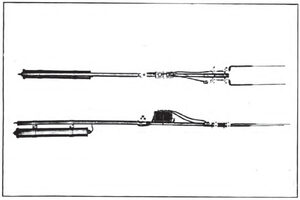
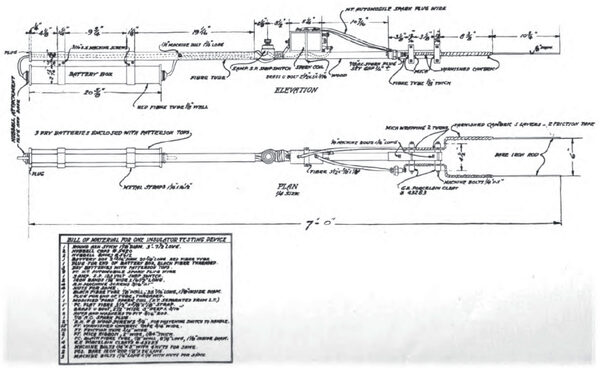
We have had difficulty in using the megger at night, because of dampness, which affects the connections between the megger fork and the instrument itself and renders resistance readings somewhat unreliable. It was our idea to work out some equipment which would be self-contained in a single testing fork and would not require any long wires connecting the test points to additional equipment on the ground. After trying out several schemes we fitted up a simple piece of testing apparatus, which we have called the Keokuk Insulator Tester. Photographs of this testing fork demonstrate its simplicity, and its construction is shown in detail on our Drawing F-1223, which is also illustrated here.
| |||
| Method of Applying Test Fork to Insulator String in Testing Out Individual Units. Fork Weighs 14 Pounds Complete and is Easily Handled on Tower. |
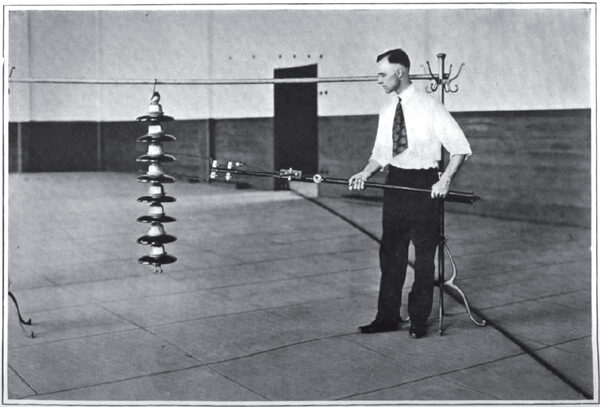
Upon the handle of the fork is mounted an automobile induction coil, the high tension winding of this coil being directly connected across the two tines of the testing fork, an automobile spark plug being connected in series with this circuit. The low tension winding of the induction coil is connected in series with three dry cells in a container at the handle end of the fork, and in series with this circuit is a 5-ampere snap switch, by means of which the induction coil can be energized during test. This testing fork is not designed for use on live lines, and any circuit on which tests are to be made must be taken out of service and protected before the fork is applied to individual units. When the line is ready for test, the fork is applied to each unit in any insulator string, and in case the unit is of satisfactory resistance, no discharge occurs across the spark gap. Whenever the fork is placed across the metal parts of an insulator unit which has failed due to thermal trouble, and which is of zero resistance, a heavy discharge occurs across the spark gap and in this way the defective insulator is easily located. This apparatus is extremely simple and does not embody any new principles or ideas, — it merely assembles standard apparatus in such a way as to develop a device which is extremely convenient for insulator testing. As compared with more expensive instruments, the cost of the fork is small. No special parts are required which are not easily obtainable upon short notice. One set of batteries will last for a considerable period, depending upon how much testing is done. Our experience has shown that three ordinary dry cells are sufficient for testing several thousand insulator units.
During the period from June 23rd to July 26th of this year, 44,000 insulators at dead end and anchor towers on the Keokuk—St. Louis 110,000-volt lines were successfully tested with this device, and 2,087 units, or 4.74%, were found defective and replaced. As many as six testing crews were employed simultaneously during the interval between 10.00 P.M. and 6.00 A.M. An average of between 700 and 1,000 units per crew were tested each night. During the progress of testing, replacements were immediately made in all strings containing three or more defective units.
| |||
| Tester Insulator Keokuk. A Simple Device for Locating Defective Suspension Type Insulator Units. |
As soon as both lines had been completely tested, changing crews were put to work during the night hours, covering both circuits and removing all zero units not replaced during tests. In this way the weakest points in the line were first taken care of and routine changing was completed later. Notwithstanding high temperatures during July, no further thermal failures have occurred since the trouble on June 18th.
|
The present plan is to provide each of our nine patrolmen, who live at sixteen-mile intervals along the St. Louis lines, with a testing fork. Once each week during the hot weather season, each patrolman will test insulators at two anchor towers. In this way any progressive deterioration due to thermal failures will be detected before severe line trouble can develop.
This new apparatus for testing insulators has worked out so well in connection with the maintenance of our transmission system that we felt our experience would be of interest to other operating companies and that possibly this same testing equipment could be used to advantage on other transmission lines.
(1) This article discusses a new and simple device especially suited for locating suspension type insulator units which have become defective. and which can be used to advantage during the night hours.
