[Trade Journal]
Publication: Western Electrician
Chicago, IL, United States
vol. 43, no. 2, p. 27,29, col. 1,1
Twenty-fifth Annual Convention at Atlantic City
The twenty-fifth annual convention of the American Institute of Electrical Engineers, held at Atlantic City, N. J., from June 29th to July 2d, was undoubtedly the most successful meeting ever held by the organization. While the total attendance in point of members was not above the average attendance at the Institute conventions during recent years—there were about 450 members and guests—yet 'the proportion of prominent and well-known electrical engineers present and active in one way or another at one or more of the sessions was much greater than usual.
Including Louis A. Ferguson, there were present no less than 12 men that have been honored with the office of president. Charles P. Steinmetz, Charles F. Scott, Schuyler S. Wheeler, Henry G. Stott, T. Commerford Martin, Carl Hering, Samuel Sheldon, Louis Duncan, John W. Lieb, Jr., Arthur E. Kennelly and Elihu Thomson—all were there un-selfishly engaged in looking after the welfare of what has come to be the largest and probably the most influential national engineering society in America.
| |||
| Louis A. Ferguson, President - Elect of American Institute of Electrical Engineers. |
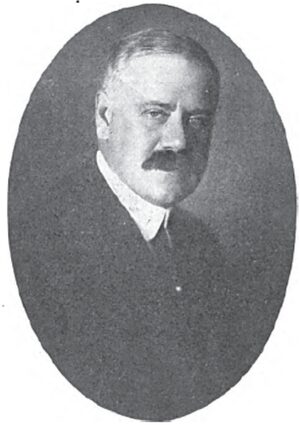
Commenting on this interesting feature of the convention at one of the sessions, President Stott said: "As a nation we frequently find ourselves asking, 'What shall we do with our ex-presidents?' As an organization of electrical engineers we ask the same question and then answer it by saying, 'We will make them work for the Institute.' There are ten of them here now, disinterestedly doing this very thing." In addition to this distinguished coterie there were present many men whose names have become household words wherever electrical engineering matters arc considered and discussed.
SOCIAL RELAXATION.
Socially, too, the twenty-fifth annual convention of the Institute was probably the most delightful of all the social affairs in which the Institute has been interested. The reception and dance given at the Casino on June 29th under the auspices of the convention committee was afterward commented on as more of the nature of an informal house party affair than of an open convention, dance. Besides this function there were many other social features, such as little dinner parties, teas at the Atlantic City Golf Club, sailing parties and evening informal dances in the pavilion on the Steel Pier.
| |||
| Secretary R. W. Pope Listening to the Wild Waves at Atlantic City |
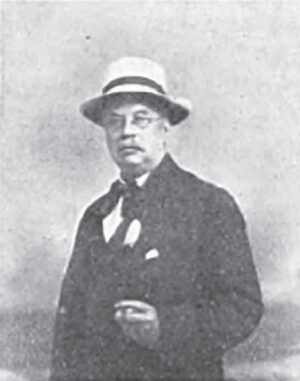
One feature that combined both engineering and social qualities is worth recording. It was quite unique. Clad in evening dress, about a score of dignified members of the Institute visited Steeplechase Pier. The men personally investigated the coefficients of friction of the "Human Niagara" and the "Shot Tower." Finally they essayed to determine the centrifugal stresses induced by riding on the "Human Roulette Wheel." While the women grouped themselves around the railing the dignitaries scrambled on the whirligig, locked arms, and waited for the thing to revolve. There sat 'twenty men of international reputation in the engineering world, but the wheel budged not. Someone asked if there were a motor of a certain well-known make operating it, to which a small boy replied in shrill tones, "The professors is stung!" Then the wheel started up, and after a few revolutions arms began to unlock, engineers to slide toward the circumference, and finally shoot off on a tangent terminating in a mattress. All but one well-known engineer of remarkable physical dimensions in a latitudinal way, who, aided by gravity, stuck fast and defied the other natural forces until the management eliminated him with a broomstick.
WORK OF THE CONVENTION.
These little social indulgences were well earned, for the men most active in them were equally active during the sessions at which the 35 papers were read and discussed. There were so many papers of more than ordinary interest and value and the discussions were so animated and protracted that only a brief outline of them can be given here. Some of them will be. considered at greater length in subsequent issues. The papers covered approximately 700 pages of the Institute Proceedings, and they were discussed verbally by about 125 men as well as in a number of written contributions. The convention programme was rigidly adhered to by President Stott and the authors of the various papers, though that entailed the presentation of nearly all the papers in abstract. With a few exceptions, all the authors. presented their papers in person. The first session began at II a. m. on Monday, June 29th, in the music room of the Hotel Traymore, about 30o members and guests being present to listen to the cordial and amusing address of welcome by the mayor of Atlantic City.
PRESIDENT'S ADDRESS.
Immediately after the welcoming speech President Henry G. Stott read the president's address, entitled "The Evolution of Engineering." President Stott said that more progress has been made in the engineering world during the last 8o years than in the period of 4,50o years preceding the formulation of Tredgold's famous definition. The progress has been so great and the conditions under which ¬the engineer plies his tasks are now so radically different that Tredgold's definition fails properly to reflect the conditions under which modern engineering practice is carried on. President Stott made an earnest appeal to engineers in general to be less passive and more aggressive in their allegiance to their engineering societies, to take a more active and potent interest in the political, economic and social affairs of the world—in short, to keep control of the machinery that they have so largely created. The address concludes with a new and broader definition of engineering than that formulated by Tredgold: "Engineering—the art of organizing and directing men, and of controlling the forces and materials of nature for the benefit of the human race."
ELECTRICITY AND THE FIRE HAZARD.
C. M. Goddard of Boston, recently elected president of the National Protective Fire Association, then presented a paper. entitled "Electricity as viewed by the Insurance Engineer—Should the A. I. E. E. Interest Itself in Fire Protection?" Mr. Goddard cited the great disproportion in the annual fire loss per capita ill Austria, Denmark, France, Germany, Italy and Switzerland and that in the United States. In the United States this loss is $2.47 per capita per year; in the above-mentioned countries it is 33 cents, or about one-eighth. The fire loss in the United States is chiefly due to carelessness, probably our national characteristic, and electricity may be a most serious fire hazard. Mr. Goddard said further that no small part of the progress of the art of electrical engineering has been due to the fact that in its early days, when the electrical engineer knew little about the fire hazard of electricity, the underwriter, knowing less but fearing much, caused this subject to be carefully considered and guarded against. , He then asked for earnest co-operation between the electrical and the fire underwriting interests, so that necessary restrictions should not obstruct but advance and safeguard the electrical undertakings.
GOVERNMENT POLICY IN WATERPOWER DEVELOPMENT.
In the absence of Frank G. Baum of San Francisco, his paper was presented in full by Percy H. Thomas of New York, chairman of the meetings and papers committee. Mr. Baum outlined a government policy regarding waterpower development, considering the matter from two points of view—the preservation of the natural resources and the protection of the enterprises. In concluding his paper Mr. Baum said among other things: "The proceeds from any particular privilege cannot be devoted to any other watershed or any other section, or for any purpose except the particular privilege." In the discussion which followed the reading of these three papers nearly all of it was centered in the sentence quoted above from Mr. Baum's paper. Messrs. Finney, Steinmetz, Jackson, Wells and others contended that Mr. Baum's views are narrow and untenable; that as a matter of governmental policy there would be no more justification for devoting the proceeds of any particular watershed only to that watershed than there would be for administering the proceeds from the New York post office solely for the benefit of. New York.
PRESIDENT-ELECT FERGUSON'S SPEECH.
Following the presentation of the papers, President Stott introduced President-elect Louis A. Ferguson of Chicago. President-elect Ferguson was greeted with prolonged applause. In an interesting and brief off-hand address, President Ferguson outlined his policy regarding the executive administration of the Institute during the coming year. He said that the welfare of the Institute would undoubtedly be furthered if a larger number of young men could be brought to appreciate the benefits arising from active Institute work; that the Institute's interests would be still further advanced if more men of broad executive training could be induced to give the Institute the benefit of their experience and judgment.
AUTOMATIC TELEPHONY.
At the session lasting from two o'clock to five o'clock. on Monday afternoon, there were presented two papers on the general subject of telephony, one on measurements of rotary speeds of dynamos and one on electric heating. W. Lee Campbell of the Automatic Electric Company of Chicago presented a paper treating of the large economic waste involved in the wire, cable and conduit equipment of a telephone system. He enumerated the reasons which make this waste necessary or expedient in manually operated systems and expressed his ideas of how this waste may be greatly reduced in systems employing automatic switchboards.
In discussing this paper E. A. Mellinger of Chicago said that virtually the only argument that can now be consistently advanced against the automatic system is the first cost of the apparatus. This is considerably greater for a single automatic exchange than for a single manual exchange, and is frequently the factor of more immediate importance that decides what equipment shall be installed. He said further that sometimes it is difficult to obtain space in a suitable location for the small sub-station serving an outlying district. In one instance this difficulty was successfully met by placing the sub-station underground in a moisture-proof cement vault, similar to those used for housing batteries in railway signal work. A manhole could be used for this purpose, constructed so as to accommodate the switching apparatus, and this would do away with the necessity for building space. From the underground sub-station to the underground branch exchange is not a long step, and although the branch office usually requires one or two attendants, the ventilating and lighting problems of an underground branch exchange could easily be solved. Considerable economy could be effected by installing such 'an arrangement in the business center of a large city, thus hastening the expansion of the automatic telephone system.
WIRELESS TELEPHONY.
In the absence of Reginald A. Fessenden of Washington, I). C., A. E. Kennelly of Boston pro-seined the former's paper, entitled "Wireless Telephony." An abstract of this paper is given or page 32 of this issue. In abstracting the paper, Dr. Kennelly made numerous running comments, particularly in regard to the receiving apparatus, the transmission and the great obstacle to long-distance wireless telegraphy and telephony—atmospheric absorption. It was stated that the amount of power necessary for wireless telephony may therefore be taken as approximately five to fifteen times that necessary for wireless telegraphy.
MEASUREMENT OF ROTARY SPEEDS.
Dr. Kennelly then presented a paper entitled "The Measurement of Rotary Speeds of Dynamo Machines by the Stroboscopic Fork," written by himself and • S. E. Whiting. In abstracting this paper, Dr. 'Kennelly said that the stroboscopic fork has been known and used by physicists for some time, but has only recently been employed for measuring the speeds of dynamo-electric machinery. An early type of this instrument was devised by Dr. Charles V. Drysdale of London, employing a conical roller device. This instrument was not portable. Dr. Kennelly exhibited a portable stroboscopic fork devised by himself and Mr. Whiting and put it into operation to illustrate his remarks. In this modified form of fork the rate of vibration can be varied through a range of about five per cent. above or below the mean value of 1,800 peeps per minute. The fork is driven by an electromagnet, receiving energy from a small dry cell. By means of a target containing five disks, with from 4 to 18-point patterns, the fork, at its normal speed, will indicate from one-half to one-eighteenth of synchronous speed.
In discussing this paper, Messrs. J. B. Taylor, Clayton R. Sharp and Prof. C. A. Perkins described stroboscopic devices used by them for simi lar purposes.
HEATING PLANT AT BILTMORE.
Charles E. Waddell then briefly abstracted his paper relating to the heating plant of the Biltmore (Vanderbilt) estate in North Carolina. He gave the reasons for the substitution of electricity for fuel and presented an account of the experiences with the plant at Biltmore. All laundry apparatus works interchangeably on direct or alternating current. The house is heated by hot water circulated by gravity. In the discussion on this paper, in answer to questions asked, Mr. Waddell said that the electric energy could be bought at o.8 cent per kilowatt-hour, but even at this low rate the cost of the heat by electric means was considerably more than that required by the furnace. But the furnace re-quired more attendants than the electric heater, and there were none of the annoyances usually found with coal and ashes.
LIGHTNING AND LIGHTNING PROTECTION.
Perhaps the most important session of the convention was that of Tuesday morning. At this session there were presented three papers on the general subject of lightning phenomena and its control by Prof. E. E. F. Creighton of Union University, Schenectady, Ernst J. Berg of Schenectady and Percy H. Thomas of New York. Those competent to express a valuable opinion pronounced M1. Creighton's paper a classic on this important branch of electrical engineering—a subject that has been constantly before the Institute for the last 10 or 15 years. Mr. Creighton's paper gave a report in detail of the study of lightning and the operation of lightning arresters during the last year on two lines well up in the Rocky Mountains of Colorado. These experiments were supplemental to laboratory experiments carried on during the last two years. The paper described the instruments and methods used in the measurements of duration, potential, current, frequency; also the resistance of cement tinder the heating effect of dynamic current, as well as the results of other closely related tests. The subject-matter of the paper was considered under six general heads: ( t ) Characteristics of lightning; (2) subdivision of frequency; (3) miscellaneous observations; (4) general comments on the arrester equipment of the Animas company; (5) earth connections, and (6) cement as a resistor. It should be noted in passing that Mr. Creighton prefers to coin a new word "resistor" to distinguish a contrivance from one of its attributes. He chooses to say "The resistance of the resistor" rather than "The resistance of the resistance." The six general heads referred to above were further subdivided into 51 specific heads, each one of which Mr. Creighton treated exhaustively. These brief references will give an idea of the nature and extent of this valuable treatise.
Mr. Berg's paper contained a description of a number of tests with arcing grounds which were undertaken with the hope of being able to deduce therefrom some mathematical expression which would represent these phenomena with reasonable accuracy. Though the mathematical expression did not materialize, the results of the tests are evidently of interest and value. The author's conclusions are that with increasing line voltages it may be desirable to resort to sonic new methods of 'protecting the winding of transformers and other apparatus connected to high-potential lines.
Mr. Thomas presented a paper involving a critical study of the paper by J. F. Vaughan on the "Lightning Records on the Taylor's Falls Transmission Line," presented at a meeting of the Institute in New York last May. After a somewhat exhaustive study of the tell-tale and other records presented by Mr. Vaughan, Mr. Thomas concluded that whether protection can be obtained from overhead grounded wires depends entirely on the arrangement of wires, the frequency of grounding, etc. Little protection is obtained from lightning rods located beside the line. Station arresters of the best types should, in the absence of severe discharges close to the station, protect adequately the station apparatus if properly insulated. Horn arresters as installed at Taylor's Falls with some paths to ground without adequate series resistance are not non-arcing and can be relied upon occasionally to shut down the plant. Both the electrolytic and the low-equivalent arresters showed themselves properly non-arcing. Finally the size of the punctures in tell-tale papers produced by the discharge of one of the waves of static after passing along the line does not in the worst case exceed a very few hundredths of an inch in diameter, while the disturbances striking the line directly caused much larger punctures.
The discussion on these papers was valuable and protracted. Many of the recognized authorities on lightning phenomena and lightning arresters were at the meeting' or sent communications by letter referring to the conclusions arrived at by the several authors. Messrs. McClellan, Fraser, Steinmetz, Thomas, Neall, Vaughan, Lincoln, Osgood, Taylor, Creighton, Rushmore, Berg and Kennelly contributed in one way or another to this informing discussion. The consensus of opinion seemed to be that the most satisfactory general solution of the elusive lightning arrester problem lies in the proper use of the overhead grounded wire.
Dr. Kennelly's summary was so concise and so illuminating that it is given here virtually verbatim. He said: "It is my expectation that we shall never have any system of absolute, complete protection against lightning, even with the best devices we can install in the station or the most perfect system of overhead grounded wire that can be devised. We shall always have some trouble left. Anyone that looks for a complete panacea against lightning is taking a very high position, which is apt to meet with some discouragement. Mr. Thomas, apparently, thinks that the disturbances are due largely to one cause, while others are equally sure that direct strokes are subordinate to 'inductive disturbances. The sources of lightning trouble are numerous and varied. I believe that we should not attempt to formulate a rule and declare that all disturbances in overhead transmission wires have one and the same origin. We must expect that with a number of disturbances a number of different kinds of protective apparatus will have to be installed, each bit of apparatus to look after the kind of disturbance to which it is best adapted."
| |||
| Resolutions in Honor of Mr. Scott |
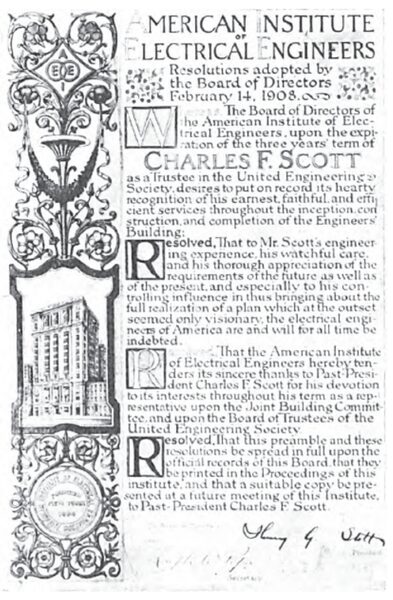
In a written contribution discussing Mr. Thomas' paper, J. F. Vaughan of Boston, said that Mr. Thomas believes that the more pronounced disturbances have been due to some form of direct discharge between clouds and line ; but as a matter of fact no clouds have been observed sufficiently low and close to the .ground to account for short direct strokes, nor have any spill-overs been actually seen. Close watch is being kept on the Taylor's Falls (Wis.) line this summer to get information on the appearance of clouds and line during spill-over, and the nature of insulator breaks is being further studied. In the course of his remarks on these papers, Dr. Steinmetz said that as many valuable tell-tale papers were undoubtedly destroyed by fire caused by the lightning discharge, perhaps it would be advisable to make the tell-tale papers fireproof by saturating them with a solution of tungstate of sodium.
John B. Taylor, after commenting on the value of the overhead grounded wire as a lightning arrester, branched off and discussed the nomenclature adopted by both Mr. Creighton and Mr. Thomas. Mr. Taylor thought that the use of the word "lightning" to indicate anything abnormal in a transmission iine was confusing.; he believed that the definition of lightning should be more restricted, in accordance with common usage. Mr. Taylor also objected to the use by Mr. Thomas of the word "static" as a noun to indicate any condition other than a state of rest.
William McClellan said that the subject of lightning protection is a two-part problem—the station and the line. The station apparatus can be protected by one means or another—choke-coils, various types of arresters, extra end-turns on transformers, etc.—but the real problem is to protect the line. If the line could be equipped with the same sort of protective apparatus that is found in the stations, much of the trouble would be eliminated.
In discussing these papers. J. W. Fraser of the Southern Power Company, Charlotte, N. C., said that in addition to grounded wire over both steel and wood pole lines, the company had installed last autumn and this spring 14 aluminum-cell arresters at various points on the lines. Several severe storms have passed over different parts of the lines since these arresters were put into service. The arresters seem to be doing good work. Although there are 315 miles of 44,000-volt line with 98 transformers, and 50 miles of 11,000-volt line with 48 transformers in service, only one transformer has been lost by causes traceable directly to lightning.
It has been the intention of the Southern Power Company to make a systematic study of lightning and freak voltages, but so far all that has been clone is to keep an accurate log of all disturbances on the lines since January 1, 1908. Out of the 21 lightning storms that have passed over the lines since that time, 18 were severe and three were moderate. Out of eight storms there was no damage of any kind. Out of five storms a total of a dozen insulators had either one of two petticoats broken off. In two storms two meters were damaged. In two storms one leg of three 44,000-volt oil switches was punctured. In one storm one 2,200-volt oil circuit-breaker blew up. In one storm transformer leads burnt off two transformers inside the case. In two storms the line grounded through a punctured insulator and (lid considerable damage.
HYDRO-ELECTRIC ENGINEERING.
Mr. Fraser then presented a paper giving the conditions under which a successful hydro-electric power system can lie created: (i) A sufficient source of power; (2) a market for the sale of power within economical transmitting distance; (3) the necessary capital. He then described in detail the conditions relating to the sale of power that determined the design of the systems of the Southern Power Company. It was considered that 44,000 volts was preferable to a higher pressure, because the distance over which the power is transmitted is so limited that the saving in copper by raising the pressure would be more than overcome by the extra cost of the apparatus for generating a higher electromotive force. The first motor installations in cotton mills on this system were of 55o volts, but it was soon seen that the number of small transformer sub-stations, besides complicating operation, would cost excessively, and after some investigation 2,000-volt motors were recommended. Today more than one-half the total horsepower in motors is at 2,000 volts.
Owing to the late hour the discussion on this paper was curtailed. Mr. Thomas, however, said that Mr. Fraser deserved the thanks of all the members of the Institute for discussing so frankly the conditions under which the Southern Power Company's system was installed and operated.
THREE-PHASE POWER FACTOR.
In the absence of Austin Burt of Waterloo, Iowa, his paper, entitled "Three-phase Power Factor," was presented in abstract by Mr. Thomas.' The author derives from the various relations that exist between the electromotive forces and currents in a three-phase, delta-connected system a general expression which will enable the mean power factor to be determined exactly; and secondly, he develops a method by which the required values employed in the above expression may be readily determined from the standard switchboard instruments.
HIGH-TENSION TRANSMISSION.
At the evening session of Tuesday papers on 'high-tension transmission matters were presented by Ralph D. Mershon of New York, D. R. Scholes of Chicago and C. E. Skinner of Pittsburg.
Mr. Mershon's paper contains a brief historical account of the investigation of the phenomena existing when transmission-line conductors are subjected to high alternating voltages made by him near Telluride, Colo., in 1896-7, and at Niagara Falls from 1904 to 1907. A summary of this paper will be given in a later issue.
Mr. Scholes was - not present, so his paper was presented in abstract by Mr. Mershon, chairman of the high-tension transmission committee. Mr. Scholes' paper contained a discussion of certain basic considerations relating to the design of transmission-line structures. The author treated his subject under the general heads of wind pressure on structures; factor of safety; wind pressure on cables; sleet; accidents, as breaking of wires, etc.; foundations. Towers should resist a wind pressure of 40 pounds per .square foot on their members, allowing a factor of safety of from 1.5 to 2. The wind pressure on cables of long spans should not be less than 30 pounds per square foot for localities where the winds are known to be high. A factor of safety of 2 should be used here. Pro-vision should be made against a coating of ice on the cables at least one-half inch thick in combination with a factor of safety of not less than 2, based on the ultimate strength of the conductor.
Mr. Skinner presented a paper containing proposed standard specifications for the testing of high-voltage line insulators. The specifications embody information and suggestions gleaned from a large number of domestic and foreign manufacturers and - porcelain insulator users. Mr. Skinner considers the subject under three general heads: (1) Routine tests; (2) design tests; (3) methods of making tests. The subject of routine tests is subdivided into two parts: (I) Inspection; (2) dielectric tests. The subject of design tests is subdivided into four parts: (I) Mechanical tests ; (2) routine tests; (3) rain tests; (4) dew test. The subject of methods of making tests is subdivided into five parts: (1) Mechanical test; (2) dielectric tests, dry test; (3) rain test; (4) frequencies, and (5) voltage control.
PRESENTATION TO MR. SCOTT.
Before opening the discussion on these papers, President Stott announced that at a meeting of the board of directors on February 4, 1908, there were adopted resolutions of appreciation of the work done by Past-president Charles F. Scott of Pittsburg in connection with the inception, construction, completion and administration of the Engineers' Building in New York. Before the entire convention assemblage in the meeting hall Past-president Samuel Sheldon of Brooklyn then presented Mr. Scott tastefully engrossed and framed resolutions, reproduced in facsimile on this page. With characteristic modesty and gentleness, Mr. Scott acknowledged this honor in a few earnest, well-chosen words.
DISCUSSION ON HIGH-TENSION PAPER.
Past-President Elihu Thomson opened the discussion on the high-tension papers, confining his remarks chiefly to the conclusions drawn by Mr. Mershon. In general, Mr. Thomson agreed with Mr. Mershon. Past-President Samuel Sheldon discussed Mr. Mershon's paper from a theoretical point of view. Dr. Steinmetz did not agree with Mr. Mershon in regard to the "critical point," asserting that this point would be at a voltage considerably higher than that mentioned in the paper. Percy Thomas considered the subject of high-voltage measurements from two points of view—its• scientific interest, and its value in connection with commercial transmission work. A number of other men took part in the discussion on Mr. Mershon's paper, all the remarks, however, focusing on the two parts of the" paper that relate to the generosity of Mr. Mershon's patrons, and the critical point in the curve connecting loss and voltage at which the loss begins to increase rapidly. Written communications on the papers by Messrs. Scholes and Skinner were received from N. J. Neall of Boston.
DISCUSSION OF WAVE FORM.
Seven papers were presented and discussed at the session of Wednesday morning. The first two, the "Voltage Ratio in Synchronous Converters, with Special Reference to the Split-pole Converter," by Comfort A. Adams of Cambridge, Mass., and the "Application of Storage Batteries to the Regulation of Alternating-current Systems," by J. Lester Woodbridge of Philadelphia, excited the most interest. So much time was consumed by the discussors of these two papers that there were only a few moments left in which to abstract and discuss the remaining five. The papers by Messrs. Adams and Woodbridge had so much in common that they were discussed jointly.
Paul M. Lincoln of Pittsburg opened the discussion by saying that in both papers practically the only question discussed, so far as the split-pole rotary is concerned, is that of wave form. He said, further, that the matter of wave form is by no means the only one which is to determine whether this type of apparatus will stand the test of time, or find its way into the oblivion of the monocyclic system and "similar skeletons of former hopes." Mr. Lincoln said that the split-pole method of obtaining a variable voltage must be compared with other methods of obtaining the same results. not only with respect to wave form, but also with respect to relative capacity, cost, efficiency, commutation, power factor, weight, floor space, heating, reliability, noise, resonance, rapidity of voltage change, liability of hunting, etc. Mr. Lincoln then referred to his previous discussion on this subject before the Institute last February, and said that his statement, "With a field form other than a sine, the wave form across the electrical diameter deviates from sine form less than that across any chord," though perfectly true for the general case, does not apply to the case of the rotary converter as ordinarily constructed.
Mr. Lincoln then took up the subject of wave form and dwelt at length on the fundamental form and the various harmonics, and concluded by saying that this type of rotary is effectually barred from Edison three-wire circuits where the' neutral is brought out from the transformers and connected to the neutral of the lighting system. He declared that any attempt to use the machine in this service would superpose the third. harmonic upon the direct-current circuit, and also cause circulating currents in the transformer windings if more than one transformer were tapped into the neutral. He then took up in detail the matters of capacity, costs, commutation, etc.
In discussing "resonance" Mr. Lincoln said that the large capacity in long-distance transmission systems, taken in conjunction with the reactance of the transformers, presents the possibility of resonance. He said, further, that although the three-phase connection of a split-pole rotary eliminates the third harmonic and all multiples thereof, Professor Adams' paper shows that all other harmonics appear in the system to exactly the same extent in the 12o° electromotive force wave as in the 180° wave. In concluding, Mr. Lincoln said that in his opinion the split-pole rotary has disadvantages that far outweigh its advantages.
Dr. Charles P. Steinmetz then took up the discussion and considered, step by step, all of the many arguments advanced by Mr. Lincoln. With the aid of blackboard diagrams he discussed for fully three-quarters of an hour the design of the split-pole rotary converter. This lecture is merely referred to here; it may be published in full, with accompanying diagrams, in a later issue. Dr. Steinmetz said, in concluding, that the mathematical, fictitious, imaginary third harmonic vanishes somewhere in this machine; it does not exist between the primary lines.
W. L. Waters of Milwaukee said that the use of storage batteries to take care of peaks on an alternating-current system is entirely a question of cost. He added that though Messrs. Adams and Woodbridge had worked out in an interesting way the mathematical theory of the split-pole rotary, showing that it is possible to attain a considerable voltage variation without introducing serious distortion of wave form, he doubted whether this would be strictly true in practice. He said that the electrostatic capacity between the different parts of the armature winding and frame causes local higher harmonic circulating currents and a tendency for the higher harmonics to reappear in the voltage wave form. Mr. Waters said that a booster combination is more flexible, quicker acting, and introduces no distortion or circulating currents into the system, and that the split-pole rotary at the present time can only be considered as a theoretical proposition, as something to be considered in special cases where its peculiar disadvantages are not liable to be serious.
DYNAMO DESIGN.
Following the protracted discussion on these two papers, B. A. Behrend of Milwaukee briefly abstracted his descriptive paper entitled "A New Large Generator for Niagara Falls." W. L. Waters abstracted his paper on "Modern Development in Single-phase Generators," and Jens Bache-Wiig abstracted his paper on the "Application of Fractional Pitch Windings to Alternating-current Generators." These papers, being somewhat special in character, and of interest chiefly to the designing engineer, the discussion was not of general interest. Messrs. Rushmore, Foster, Steinmetz, Jackson and Waters participated. Mr. Waters made some comments on Mr. Behrend's paper, to which Mr. Behrend declined to reply.
STEAM TURBINES AND GAS ENGINES.
J. R. Bibbins of Pittsburg then abstracted his two papers—"Double-deck Steam-turbine Power Plants" and "Working Results from Gas-electric Power Plant." The latter will appear in full in a later issue of the Western Electrician. Owing to the lateness of the hour—it was almost 1:30 p. m.—C. W. Ricker of Cleveland was the only discussor. In his discussion he gave a complete, detailed analysis of the cost per kilowatt of the West Point power station of the Youngstown and Ohio River Railroad. The total cost of the 3,000-kilowatt power station was $246,170, or $82.06 per kilowatt. The total cost of the sub-station equipment in the power station was $12,600, or $4.20 per kilowatt. The total cost, then, of the station and sub-station was $258,770, and the total cost per kilowatt was $8626.
ELECTRIC RAILWAYS.
The session on Wednesday afternoon was devoted to the general subject of electric railways. Four papers were presented in abstract by J. B. Whitehead of Baltimore, H. C. Specht of Pittsburg, Gerard B. Werner of New York and S. B. Fortenbaugh of Schenectady. In the absence of Mr. Fortenbaugh, his paper was presented by Mr. Thomas.
Professor Whitehead's paper described the Annapolis Short Line, a line 25 miles long, which is to be changed from steam to electric operation. Detailed estimates, given in the paper, indicate that the total cost of electric operation and maintenance is about 16.6 per cent. more than that under steam operation. A 25-cycle, 6,600-volt system has been selected, power being obtained from single-phase generators. The trolley is fed directly from the generators, as are also step-up transformers for the 17.5-mile transmission to the sub-station.
In discussing this paper A. W. Copley gave some valuable tabulated results of tests made on the New York, New _Haven and Hartford Railroad under the direction of Charles F. Scott and W. S. Murray. Mr. Copley referred to the figures given by Mr. Whitehead for various losses in railway circuits, figures compiled by Messrs. Parshall and Hobart and by the Railway Test Commission, and Mr. Whitehead's theoretical considerations thereof. He then compared these data with those obtained by him during the New Haven road tests, taking them up under the specific heads of rail impedance, rail resistance, rail reactance, rail current, position of earth current, impedance volts due to trolley current and impedance volts due to rail current.
Mr. Specht presented a paper treating of the operation of two induction motors connected in direct and differential concatenation and as single machines for the purpose of obtaining variable -speed.
Mr. Werner's paper was entitled "The Determination of the Economic Location of Sub-stations in Electric Railways." The specific purpose of the paper was to develop an equation for the number of sub-stations, or the distance between sub-stations, which will render the total annual charges on the station a minimum. Mr. Werner elected the single-phase system to illustrate the general method of deducing the equation, and the charges considered were the annual charges on sub-stations, on overhead copper, cost of sub-station losses, and secondary-conductor losses. Developing the formula and plotting the curves, Mr. Werner showed that the lowest point of the curve of the total charge corresponds to that number of sub-stations at which the curve of sub-station charges crosses the curve of charges on the secondary copper.
Mr. Fortenbaugh's paper was on "Conductor Rail Measurements." It contained a summary of tests made on the third and fourth rails of the Metropolitan District Railway and the Baker Street and Waterloo Railway in London. Mr. Fortenbaugh's conclusions were:
1. That the difference of potential between the positive conductor and earth is always normally considerably greater than the potential existing between the negative conductor and earth.
2. That this difference between the positive and negative insulation becomes more marked the longer the conductors are subjected continuously to a difference of potential in the same direction.
3. That a reversal of the polarity is always instantly accompanied by a considerable increase in the normal leakage current between the positive and negative conductor.
4. The above phenomena can be repeated indefinitely and arc independent of the length of time that the pressure has been previously applied to the conductors in either direction.
5. That the insulation of the negative conductor to earth cannot be proportionately maintained.
The discussion on these papers was of a general nature, so that no specific mention need be made of it. As usual, however, the advocates of the various systems—the 600-volt direct-current, the 1,200-volt direct current, the 25-cycle, single-phase alternating current, and the multiphase alternating current—all contended for their particular system. The 1.200-volt, direct-current system seemed to have gained friends during the last twelvemonth.
SECTIONS AND BRANCHES.
One of the most interesting features of the convention was the large, enthusiastic and interesting meeting on Wednesday evening, of the representatives of the sections and branches. Representatives from the Chicago, Cleveland, Minnesota, Pittsburg, Seattle, Cincinnati, St. Louis, Baltimore, Boston, Urbana, Atlanta, Ithaca, Toledo, Norfolk, Philadelphia, Schenectady, Pittsfield, San Francisco, Columbus, Toronto and Washington, D. C., sections and' from numerous colleges and universities were present to discuss the administrative . work of the Institute from the point of view of their section or branch. The wide geographical distribution of these sections and branches and their activity ill Institute affairs stamp the Institute as distinctively national. No other national American engineering society begins to approach the Institute in this respect. Previous to the establishing of the sections and branches it was impracticable to get a consensus of opinion regarding the details of Institute administrative work from the members in any particular locality or group of localities outside of the New York district. The informal meeting was presided over by Paul Spencer of Philadelphia, chairman of the sections committee. At this meeting Mr. Spencer invited free and full expressions of opinion from all the representatives present, asking particularly for practical suggestions for closer working relations between the sections and branches and Institute headquarters. An interesting discussion, lasting from 8 to II:30 p. m., followed this invitation.
GENERAL EQUATIONS OF THE ELECTRIC CIRCUIT.
Six papers were presented at the session of Thursday morning. Dr. Charles P. Steinmetz abstracted his classic paper on "The General Equations of the Electric Circuit," stating that the paper is still incomplete and may require some modifying; that the paper represents an attempt to investigate mathematically the - phenomena that may occur in the most general case of an electric circuit, and that the general equations of the electric circuit call be derived under the condition that the attributes of the electric circuit—resistance, inductance, conductance and capacity—are constant. He then proceeded briefly to derive and discuss these equations by means of blackboard diagrams, devoting the larger part of his discourse to an analysis of traveling waves and oscillations.
In opening the discussion on this paper, President Stott said that the subject is so important and so complicated and abstruse that justice could not be done to it at one meeting; that its consideration should extend over a series of meetings. Dr. Bedell of Ithaca, N. Y., thought that a paper of this character should be presented at one convention and discussed at the next one. Prof. Dugald Jackson of Boston commented on the simplicity of Dr. Steinmetz's equations, adding that these equations actually represent the facts. He commented on the almost total disregard of imaginary quantities in arriving at the results obtained. After discussing somewhat at length the purely mathematical features of the paper, Professor Jackson said that Dr. Steinmetz is the first man that has had the courage to make a direct attack on this abstruse and involved subject. Prof. John Price Jackson of State College, Pa., followed with an amusing and highly imaginative hydro-mechanical analogy of the paper, evolved the night before, Ile said, in the effort to get at a physical conception of the actual facts.
PRIMARY STANDARD OF LIGHT.
Following this, Dr. Steinmetz presented in abstract his paper entitled "Primary Standard of Light." This paper was discussed by Clayton Sharp, J. B. Taylor. E. B. Rosa, C. P. Steinmetz, C. A. Perkins, A. E. Kennelly and E. P. Hyde. Mr. Taylor expressed surprise at Dr. Steinmetz's versatility, but wondered why wave lengths are used in making comparisons in the case of either light or sound; wave lengths are different in different media, he said; one thing in wood, another in water, another in air, and still another in hydrogen. He thought that comparisons of frequency would be more rational in matters of this sort.
ELECTROMAGNETIC INDUCTION.
Dr. Carl Hering of Philadelphia then abstracted his paper entitled "An Imperfection in the Usual Statement of the Fundamental Law of Electromagnetic Induction." As this paper and the written discussion on it had already been published in the Proceedings, there was no further discussion at the convention.
GRAPHICAL TREATMENT OF THE ROTATING FIELD.
R. E. Hellmund of Pittsburg abstracted his paper, entitled "Graphical Treatment of the Rotating Field," saying that the object of the paper was to evolve diagrams by means of which nearly all the phenomena of the rotating field may be easily studied. He considered numerous points in electrical machine design, such as fluxes in the individual teeth, space values of the total field, potentials, characteristics of the rotating field, reactance factor, etc., treating them all graphically. He said that the graphical treatment always gives clearer conceptions of physical facts than can be obtained from analytic formulas.
SOLUTION OF ALTERNATING-CURRENT PROBLEMS.
In the absence of Harold Pender of New York, Percy H. Thomas presented in abstract the paper entitled "A Minimum-work Method for the Solution of Alternating-current Problems." An abstract of this paper will be given in a succeeding issue. In discussing this paper, Mr. Thomas said that to him the actual value of the paper as a saver of work lay rather in the tables given than in the method adopted by the author. Professor Comfort Adams thought that short-cut methods of this nature are of interest to comparatively few people ; compared with natural methods, said Professor Adams, they are of but little value to the student.
COPPER AND IRON IN ALTERNATORS.
The last paper of this session, "The Relative Proportions of Copper and Iron in Alternators," was presented by Carl J. Fechheimer of Cincinnati. In abstracting this paper, Mr. Fechheimer said that a problem constantly before the electrical engineer is, how shall the flux and number. of conductors be related to each other, the product of these two being fixed by the voltage, frequency, and speed. In the method pursued by Mr. Fechheimer, equations are derived for the weights of the principal parts of the alternator, the weight in each case being expressed as some factor which is easily determined, multiplied by some power of the flux per pole. The weight of these parts is then multiplied by the price per pound of material used and by some other factor to allow for the unavoidable scrap material. The sum of these costs will give the cost of the material in the principal parts of the machine in terms of the flux. The method is only an approximation, but the author believes it sufficiently accurate for commercial purposes. The paper concludes by applying the method proposed to the, design of a three-phase, 60-cycle alternator.
In discussing this subject. W. L. Waters said that this paper is perhaps useful in an academic way to beginners and students, but for practical purposes designers will have to stick to the old methods formulated by experience.
TRAINING OF THE ELECTRICAL ENGINEER.
At Thursday afternoon's session three papers on the general subject of the training of the electrical engineer were presented by M. W. Alexander of Lynn, D. B. Rushmore of Schenectady and B. A. Behrend of Milwaukee. The papers by Messrs. Rushmore and Behrend were general in their nature: the paper by Mr. Alexander described specifically a purported co-operative method of training engineers so as to increase their efficiency. According to the plan proposed, which is about to be adopted by a large electrical manufacturing, company and one of the leading technical schools. the student is to spend six years in gaining technical education and factory experience. In the method proposed the student spends the first five years in alternate periods at the college and at the factory, the sixth year being confined exclusively to college work. The length of the alternating period is all important element in this plan, for too long or too short a time may defeat the objects which the alternating, co-operative course seeks to accomplish.
This paper was discussed somewhat vigorously and at length. So intent were the debaters on centering their opinions on the alternating feature of Mr. Alexander's paper that they quite forgot the other two educational papers. Prof. John Price Jackson argued for more culture studies in the course, and suggested that practicing engineers should become "consulting professors," and said, further, that until the practicing engineers agreed to do this the colleges could not do the work that the engineers want them to do. Mr. Behrend criticized Mr. Alexander's alternating plan on the ground that one week here, one week there, would teach the student anything but concentration. Percy H. Thomas of New York and Prof. Morgan Brooks of Urbana, Ill., were skeptical regarding the result of having the student alternate during his college training between the desk and the machine.
Dr. Steinmetz discussed the subjects of education and training at length. He said that the university labors under a great disadvantage in attempting to make electrical engineers out of all the mediocre material that is dumped on it. He thought that there should be different kinds of engineering schools. Prof. Dugald Jackson supported Mr. Alexander's alternating co-operative plan. He compared the educating and the training of the engineer with that of the physician, who alternates between the classroom and the clinic, and thought that Mr. Alexander's plan would make the training of the engineer approach more closely to that of the physician.
Charles F. Scott and Gano Dunn argued for the broad development of the man himself, considering the methods adopted as of secondary importance. Mr. Dunn was opposed to Mr. Alexander's scheme on the ground that the average student has but little directive force and needs to be taught to confine his attention insistently upon one thing. Mr. Dunn said that an asset of great importance in a factory is a trained workman, and to have students one week on and the next week off would soon spell chaos in the organization of the factory. "The keynote to better, higher education," he concluded, "is the selective process, not only among the students but among the professors as well. The teacher should have the dramatic power to arouse thought that .will be retained vividly in the mind of the college student long after he has been graduated."
In bringing the convention to a close, President Stott spoke of the obligations of the Institute to its various committees, committees that sacrifice both time and money in order unselfishly to advance the interests of the profession. He said that the secret of the remarkable success of the Institute lies not in the kind of help that can be had for hire, but in the voluntary work of the committees, particularly the committees on finance, papers and meetings, editing, and membership.
Resolutions were then passed thanking the convention committee, the Philadelphia Section and President Stott for their labors in bringing to a fitting close the most successful year in the history of the Institute.
As noted previously, the total attendance was about 450. Of this number the following-named persons were registered from points west of Pittsburg: Louis A. Ferguson and Mrs. Ferguson, George A. Damon and Mrs. Damon, G. R. Brandon and Mrs. Brandon, H. R. King and Mrs. King, W. Lee Camp¬bell, E. A. Mellinger, R. F. Schuchardt, Chicago ; Prof. Morgan Brooks, J. M. Bryant, E. H. Waldo, Urbana, Ill.; W. S. Lee and Mrs. Lee, E. P. Coles, J. W. Fraser, Charlotte, N. C.; Fred G. Simpson, John Harisberger, Seattle, Wash.; John H. Rogers, Kansas City; A. W. Berresford, Charles E. Lord, B. A. Behrend, A. B. Field, L. E. Bogen, C. T. Henderson, 0. M. Rau, Max Palitz, C. R. Gilman, Milwaukee; F. W. Springer, Minneapolis; John H. Finney, Atlanta; Clarence E. Delafield, Mansfield, Ohio; A. H. Babcock, San Francisco; H. L. Wal-lau, J. C. Lincoln, C. W. Ricker, H. B. Dates, Cleveland; Allan Ramsey, A. H. Timmerman and Mrs. Timmerman, C. R. Meston, A. S. Langsdorf, St. Louis; Joseph F. Merrill, Salt Lake City; Carl J. Fechheimer, A. C. Lanier, Cincinnati ; L. E. Hurtz, Lincoln, Neb.; George H. Duffield and Mrs. Duffield, Rock Island, Ill.; P. E. Mitchell, Charles A. Perkins, Knoxville, Tenn.; Alexander. O'Shea, Charleston, W. Va.; H. A. Holdrege, 0. S. Hoffman, A. Rosewater, S. Rosewater, Omaha; George E. Kirk, Toledo, 0.; R. F. Garrettson and Mrs. Garrettson, Michigan City, Ind.; Prof M. C. Beebe and Mrs. Beebe, Madison, Wis.; J. McA. Stevenson, San Antonio, Tex.; G. Wilbur Hubley, Louisville; P. N. Nunn, Provo, Utah; P. D. Brown, Youngstown, Ohio; C. F. Harding, Lafayette, Ind.; Prof. H. S. Carhart, Ann Arbor, Mich.
