[Newspaper]
Publication: Rochester Democrat and Chronicle
Rochester, NY, United States
p. 1A,6A, col. 5,1-5
|
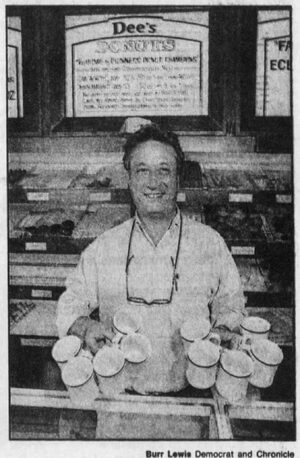
Dick Salerno, a Canandaigua donut shop owner,
with his Victor mugs, which are no longer made.
Victor mugs'
owners can't
get a refill
Local company quit making
nationally known coffee cup
By Diana L. Tomb
Democrat and Chronicle
The Victor mug is dead.
Word has been out in restaurant-china circles for more than a year, but a public wake began just last month in a catalog produced by a Martha's Vineyard bakery and restaurant.
"Our U.S. manufacturer has stopped producing these hefty 'diner-style' glazed china mugs," reported the mail-order catalog from The Black Dog in Vineyard Haven, Mass. "Don't miss out on the last of the best"
In the spring of 1990, Victor Insulators in Ontario County shut down production of its familiar diner mug, a unique cream-colored cylinder with convex sides and a solid handle.
Not a particularly large mug — its several varieties all held less than 8 ounces — its shape lent itself to warming one's hands around its girth.
"It’s the kind of cup a person thinks of when a person comes into a coffee shop," said Dick Salerno, owner of Dee’s Donuts in Canandaigua. Coffee comes only in a Victor mug at his shop.
Manufactured from the same porcelain that must withstand 765,000 volts on electrical transmission lines, the mug was known for being able to take about a zillion plunges from counter top to linoleum floor.
"They stand up to an incredible amount of abuse. I used to say they are practically indestructible, but there are some shipping companies that made me a liar," said Elaine Sullivan, marketing director for The Black Dog.
"I've never seen the cup directly break, unless the handle broke off," Salerno said.
Victor officials blame the cup's demise on imports. Ultima China, in China, makes a look-a-like mug that sells for less than half the price.
"That’s what finally killed it,' said Ira O. Knickerbocker, vice president at Victor. The company needs to be able to sell 25,000 to 30,000 dozen mugs annually to make a profit on mug-making. "We weren't even getting 60 percent of that," Knickerbocker said.
That goal was substantially lower than sales during World War II, when the mug was originated for use on Navy ships. John M. Saxby, personnel manager for the company, said few orders were needed to keep the company afloat, because a single order from the Navy might be for 1 million.
"Then the Army got into the act before the war was over," Saxby said. Even with the military orders, the mug was always a tiny portion of the insulator company’s business, he said. After the war, Victor made an exclusive agreement with Buffalo China to sell the mugs commercially.
The handle-less version of the mug used in the military, also was popular in stateside institutions, Saxby said.
For a while, there were cereal and soup bowls, too, and variations on the size and style of the mug. But Buffalo China found it could make a similar bowl more cheaply, partly because labor costs in the china industry are lower than in the electrical insulator industry.
Victor retained the mug because it had expertise in attaching the handles.
"There’s nothing to attach to a bowl," scoffed Knickerbocker.
Plastics took another chunk out of the mug’s market share during the 1970s, but the mug held on.
"People do not want to drink coffee, or any substance, out of something that's stained," Saxby said. And that's a problem with many plastic dinnerware lines.
Restaurateurs liked the mug, perhaps in part because it looks like it holds more than it does. It also fails to scald the drinker's hand, as some glass mugs do. But Salerno said there's such a strong association between coffee and the Victor mug that he felt he couldn’t serve in any other vessel.
The Black Dog has used the mugs for 20 years in its restaurant and sold approximately 10,000 of them, decorated with a black dog decal, since its first catalog was issued in 1988.
"We have unimprinted ones in the restaurant and we see those walking out the door," Sullivan said.
People just seem to like the ubiquitous mug, made exclusively in Victor.
"It’s the shape. It’s the weight. It’s the fact that people remember them and associate,” Sullivan said.
Travelers can attest to the mug’s popularity beyond the Northeast.
"It's not uncommon to go into a restarant anywhere in the United States and turn the mug over and see ‘VICTOR, Saxby said.
In recent years, Victor found many of its mugs were being sold to decorators — firms that attached decals to the side. Often military decals were used to make mementos for veterans.
"We make a very acceptable coffee mug for general-purpose restaurant use," Knickerbocker said. "This new breed of customer was not satisfied with our normal standard of quality."
The mug is made in the same type of machines and with the same process as Victor’s insulators. It is glazed while still green and fired once. That firing process sometimes causes tiny bubbles to form on the mug's surface, which can wreck a decal that may be more expensive than the mug.
But Victor got around that problem by making double inspections, ensuring the decorators didn’t receive mugs with marred surfaces.
When imports became a threat about five years ago, the manufacturer added “MADE IN U.S.A." to the familiar “VICTOR” on the mug’s underside.
That did little good, though, because consumers don't realize "CHINA" on the bottom of a cup can mean China — foreign-made — as well as china.
The foreign mugs are a slightly different color — a little more grey than cream. Some imitations don't weigh as much.
"Every copy that we have seen has been significantly less than the ones Victor has been making for 40 or 50 years," Sullivan said. "I want that mug. We try very hard, anything we sell, to make sure it’s U.S.-made."
She and her staff have taken to stopping by restaurant supply stores whenever they're on the mainland to amass an inventory of authentic mugs. "Anytime we went to Boston or New Bedford, we checked their basements and scarfed a few," she said.
Salerno bought three four-dozen cases a few years ago and stashed one, so Dee's won’t run out any time soon.
Company officials said they were reluctant to stop making the mug.
"It's unfortunate that the line had to meet its demise," Knickerbocker said.
But, added Saxby, "it’s just not economically feasible."
TESTING THE VICTOR MUG
Is the Victor mug Indestructible?
No, say the manufacturer and restaurateurs. But the familiar diner mug is known for its durability.
Does its electrical-insulator properties, and its manufacture on American soil make it more sturdy than, say, a copy made In China?
The Democrat and Chronicle decided to find out. We conducted a totally unscientific test of the original Victor mug, stamped "VICTOR" on the bottom, and a Chinese import. Both were purchased from Eagle Specialty Co. on State Street in Rochester.
Starting rather optimistically with a 3-foot drop onto the sidewalk behind the Gannett Rochester Newspapers building, we were disappointed to find both mugs broke. There was little difference in the way they broke or he size of the pieces.
Backing down to a 1-foot drop, we witnessed no breakage in either cup.
We moved to 18 inches.
Again, no breakage.
We upped the mark to 2 feet.
No breakage.
We went to 2.5 feet.
Both mugs broke.
But this time we noticed that the Victor mug broke into clean pieces with almost blunt edges. The Chinese mug broke into shards, causing the reporter who picked up the pieces to cut herself.
Conclusion: Indecisive because we ran out of import mugs.
A final aside: We tossed the Victor mug several times from desktop level to the thinly carpeted cement floor of the Democrat and Chronicle newsroom. The mug did not break.